Trajineras: What They Are, What They Cost, How to Hire One
A trajinera is a flat-bottomed cargo boat with a party bolted on top. Understanding what it was built for explains almost everything about how a day on the canals works.
Short answer
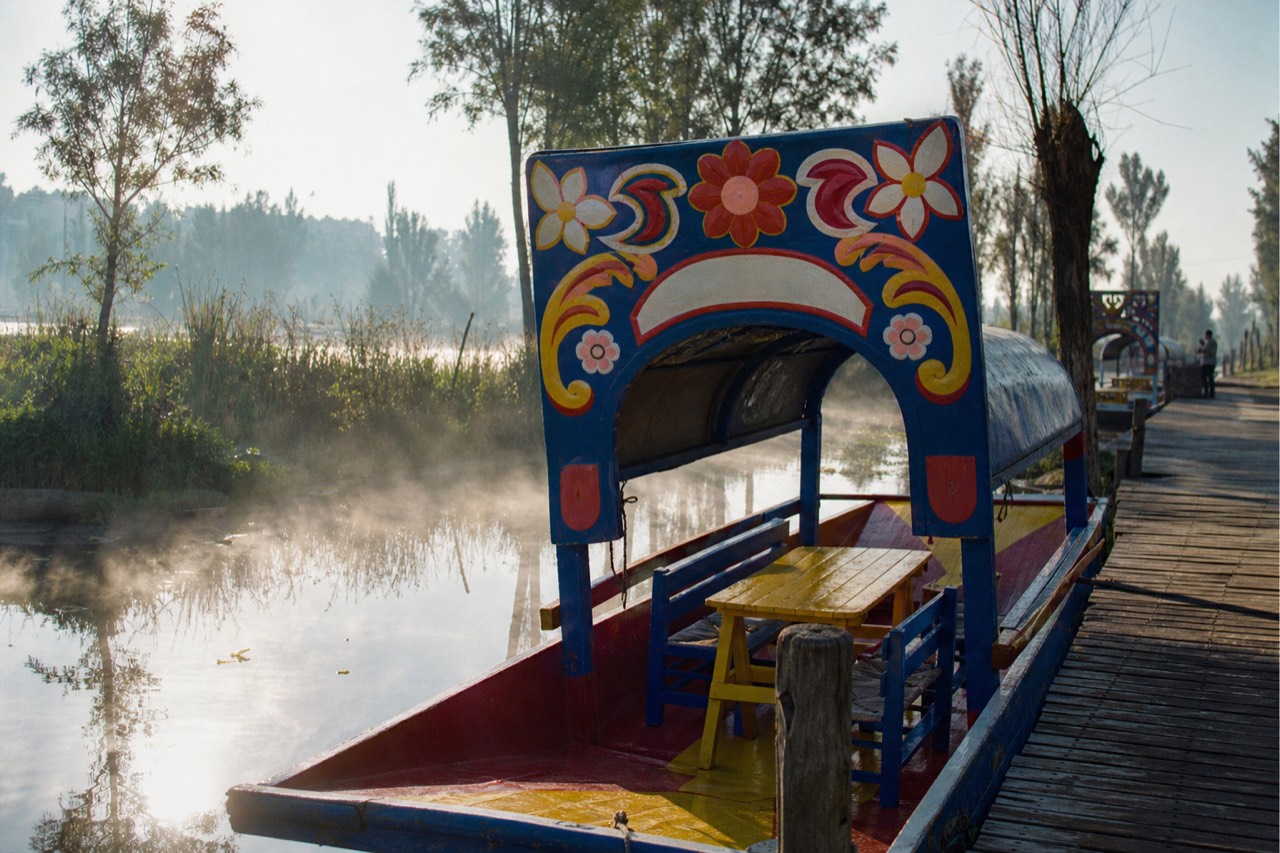
A trajinera is a flat-bottomed wooden canal boat, punted with a long pole, with an arched painted canopy and a long table down the middle. Around 1,204 are registered in Xochimilco. The borough sets the rate at 750 MXN per hour for the whole boat, not per person, with posted limits running 18 to 20 people.
The first thing you notice is the sound the pole makes. Not an engine, not oars: a long wooden pole going down into the mud and coming back up wet, and the boat moving forward in a slow push you feel through the floorboards. Then the boat behind you starts a Bronco song at full volume and the sound of the pole is gone for the rest of the afternoon. That is Xochimilco, and the boat under you is a trajinera.
I grew up going out on these. Family lunadas where my aunts loaded the table before we left the dock, Saturday afternoons that started as a birthday and ended six hours later with someone asleep across three plastic chairs, and the long haul south from Cuemanco toward the doll island that takes so much of a day that you plan it like a trip. This page is about the boat itself: what it is, why it looks like that, what it costs to hire one with nobody's markup on it, and what a booked tour gives you that the raw boat does not.
What is a trajinera?
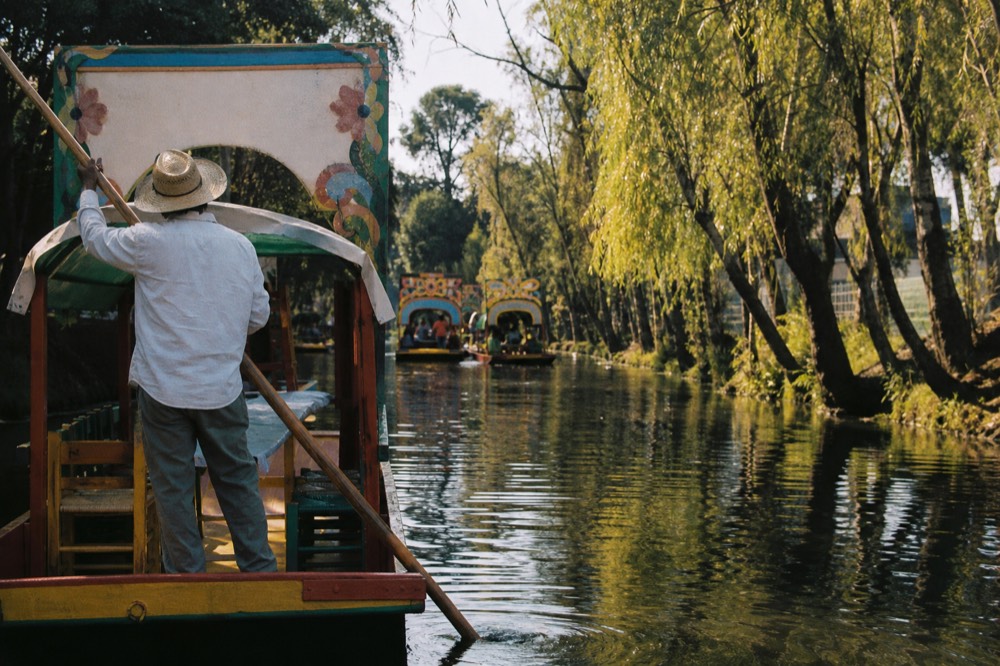
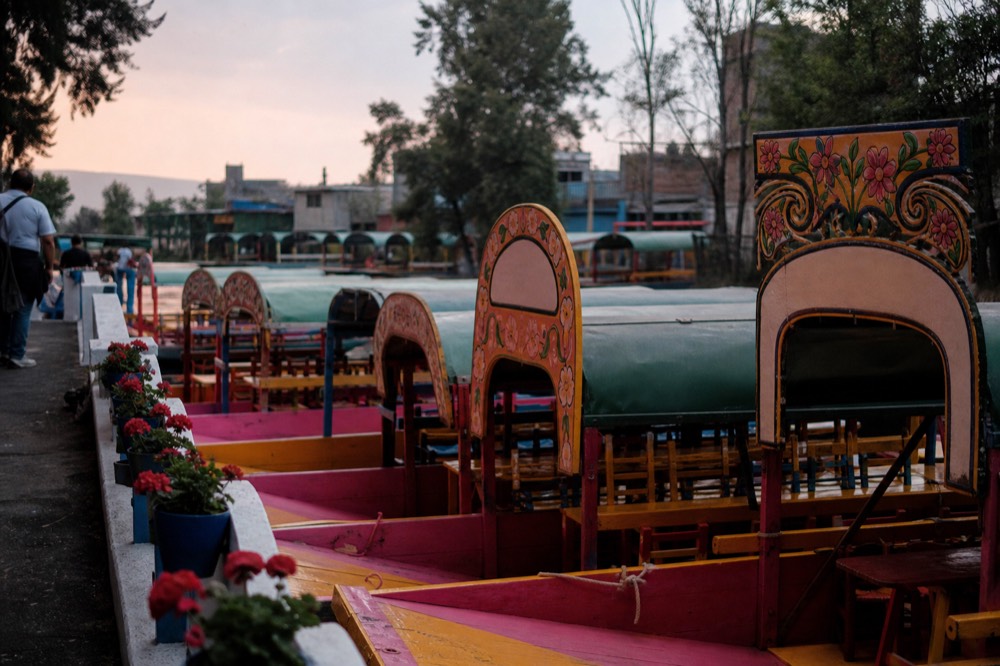
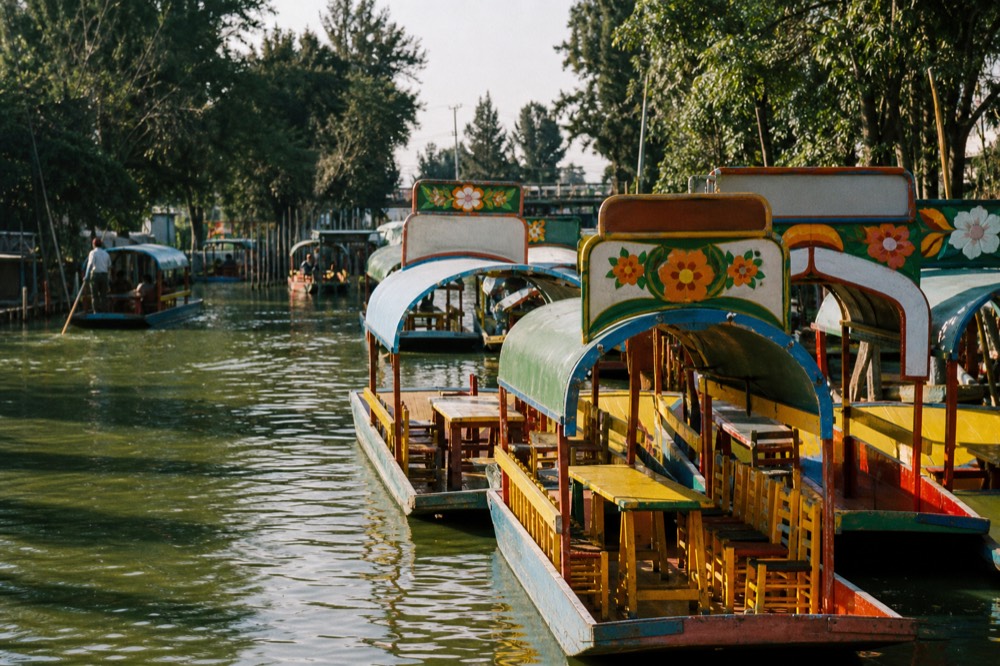
A trajinera is a flat-bottomed wooden boat, roughly barge-shaped, moved by a boatman standing at the stern with a long pole. Over the deck sits an arched canopy painted in bright colours, and under it runs a long table with chairs on both sides. It carries people now. It was built to carry vegetables.
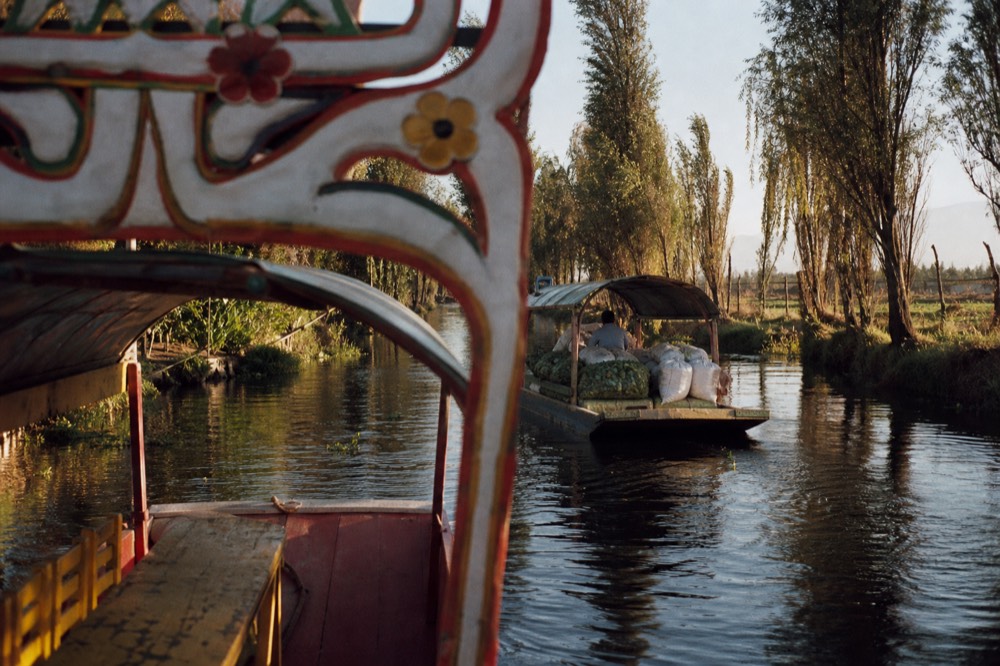
Everything odd about the design makes sense once you know it started as a work boat. The canals of Xochimilco are shallow, so the hull is flat and draws almost nothing. The chinampa plots are separated by channels barely wider than two boats, so the shape is long and narrow rather than wide. There is no engine because engines chew the banks and the beds, and because a pole in shallow water is more precise than a propeller. The boatman reads the mud with the end of that pole the way a driver reads a road.
The canopy is the part that changed. Historically the arched frame carried flowers, and the boats worked the water taking produce from the chinampas toward the city. When tourism became the borough's economy, the flowers turned into paint and the cargo deck turned into a dining room. What you sit on today is a farm truck in a party dress, and if you look at the boats moving vegetables and soil in the working sections of the canals, you can still see the original.
That working landscape is not a museum piece either. The chinampas are still farmed, which is a large part of why the canals carry a UNESCO listing at all, inscribed in 1987 as part of the Historic Centre of Mexico City and Xochimilco. What the chinampas guide covers in detail is how those plots were engineered and how they are farmed now.
What does trajinera mean in Spanish?
The word comes from trajinar, to haul or cart things about, and trajín, the bustle of moving goods around. A trajinera is literally a hauling boat, a carrier. The name says nothing about tourism, canopies or mariachi. It describes a vessel that shifts loads, which is exactly what these boats did for centuries.
You can hear the honesty in it. Spanish has plenty of romantic boat words and this is not one of them. Trajín is the sound of work: crates, sacks, back and forth, all day. When someone says they are en el trajín, they mean they are run off their feet.
That etymology is a small correction to a widespread bit of travel writing. Trajineras are frequently described as "Mexican gondolas", which is understandable shorthand and completely wrong about the boat's history. A gondola is a passenger craft, built to carry people elegantly through a city. A trajinera is a cart. The elegance was added later, by hand, in enamel paint, and it goes over the top of a hull designed to hold two hundred kilos of lettuce.
The other word you will hear at the dock is toldo, the canopy. Boatmen and the borough both use it: the registration number of every boat is painted on the toldo, and the canopy colour is one of the ways boats are sorted at the dock.
How a trajinera is built, and why it looks like that
Flat bottom for shallow water, long narrow hull for narrow canals, a fixed arched canopy over the whole deck, a table down the centre line with chairs bolted or set on both sides, and a pole rather than an engine. The paint is the personal part. Everything else is dictated by the canals.
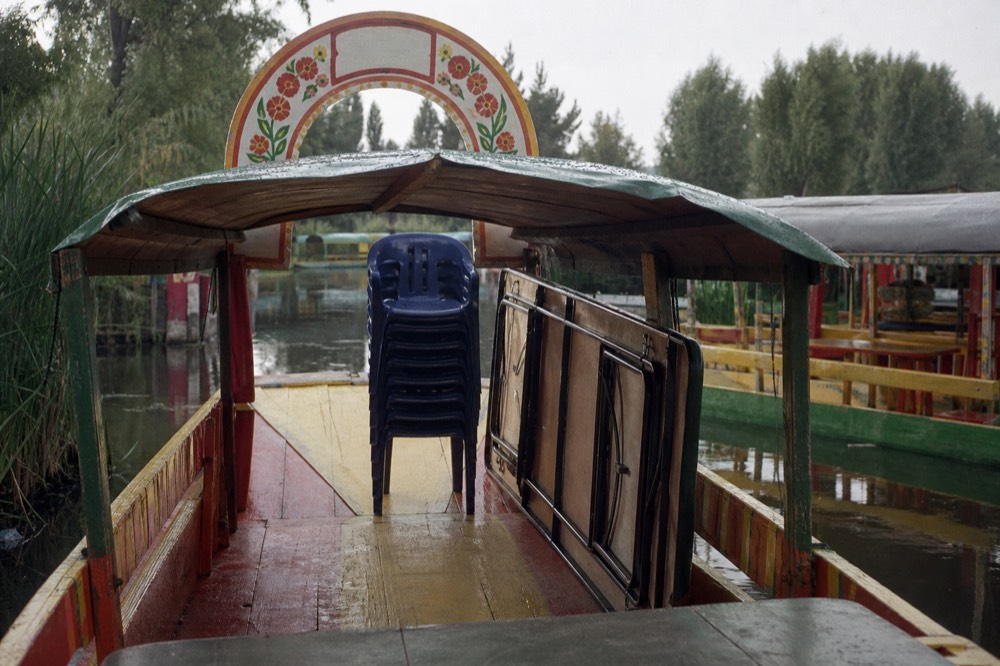
Take the boat apart and every feature has a canal reason behind it.
| What you see | What it does | Why it matters to you |
|---|---|---|
| Flat, shallow hull | Floats in water that is often knee-deep at the edges | The boat barely rocks; motion sickness is a non-issue |
| Long, narrow deck | Fits channels where two boats pass with centimetres to spare | Seating is one long row per side, so groups face each other |
| Arched painted canopy (toldo) | Full shade over the whole table | You are covered from sun and light rain, but not from wind |
| Long central table | Descended from the cargo deck | The whole day is table-shaped: food, drinks, cards, cake |
| Plastic or wooden chairs | Set on both sides of the table | Nothing is bolted down at the ends; watch bags near the sides |
| Long wooden pole at the stern | Propulsion and steering, read off the canal bed | No engine noise, no fumes, and pace is set by one person's arms |
| Registration number on the toldo | Borough registration for the boat | It is how you identify your boat and report a problem |
The paint is where boats become individuals. Colours are personal to the owner, the floral work is hand-done, and the arch across the front carries a name. Which brings us to the thing every visitor asks by the second canal.
Why does every trajinera have a woman's name?
Boats are named for daughters, wives, mothers and grandmothers, painted in scrolled letters across the front arch. It is a family-ownership tradition, not a rule from anyone. These are family assets, often passed down, and naming the boat after the women of the house is how ownership gets written on the hull.
Once you notice, you cannot stop reading them. Guadalupe, Lupita, Rosita, Carmen, Elena, Yolanda. Sometimes two names side by side, which usually means two daughters or a wife and a mother. Occasionally something that is nobody's name at all, a saint or a place, but the pattern holds across the fleet.
They are also a navigation system. Boats do not have berths in any organised sense at the busy docks, so when your boatman ties up for a stop and you go wandering along a landing to buy beer, the way you find your boat again is the name on the arch and the number on the canopy. Photograph both before you leave the boat. That advice sounds unnecessary until you are standing on a crowded dock at Nativitas at four in the afternoon looking at sixty painted canopies that all look identical from behind.
About 1,204 trajineras are registered across the borough, spread over 11 official embarcaderos. That is a lot of boats and a lot of names, and every one of them belongs to somebody's family.
How much does it cost to hire a trajinera yourself?
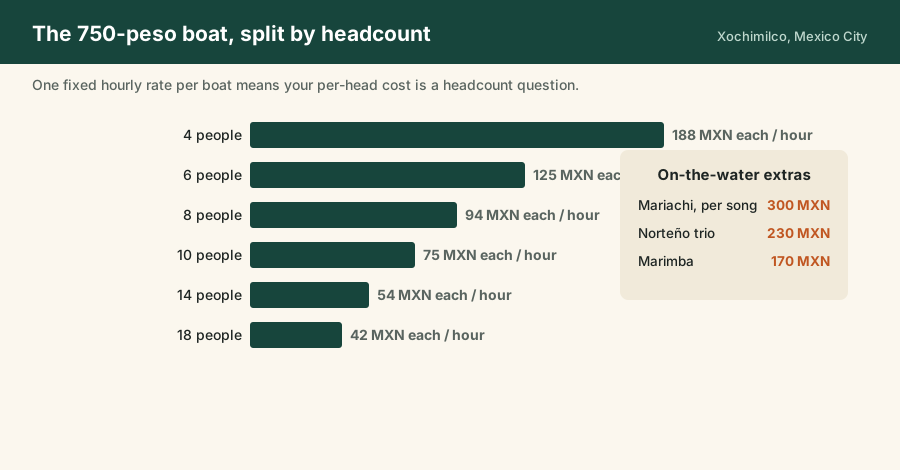
The borough sets the official rate at 750 MXN per hour for the entire boat, not per person. Two hours costs 1,500 pesos regardless of whether four people or eighteen are on board. Anyone quoting a per-person price at the dock is breaking the posted tariff, and the tariff is posted where you can see it.
This is the number that changes the whole day. Split across a full boat, the official rate is around 40 pesos per person per hour, which is less than a beer. Split across four friends, the same boat costs almost ten times that per head. The boat is priced as a unit, so the arithmetic is entirely about how many of you there are.
| Hours on the water | Boat total (MXN) | Split by 4 | Split by 8 | Split by 12 | Split by a full boat |
|---|---|---|---|---|---|
| 1 hour | 750 | 188 | 94 | 63 | around 40 |
| 2 hours | 1,500 | 375 | 188 | 125 | around 80 |
| 3 hours | 2,250 | 563 | 281 | 188 | around 120 |
| 4 hours | 3,000 | 750 | 375 | 250 | around 160 |
Splits are rounded and assume a full boat at the posted limit for the last column. The rate itself is set by the borough and reported nationally, and it has held steady through 2025 and 2026.
Two hours is the standard first outing and it is genuinely enough to see the tourist canals, buy something from a vendor canoe, and get a song. Three to four hours is what locals book when the point is the boat rather than the sightseeing, because you settle in, you eat properly, and you stop checking the time. The full price breakdown puts this rate side by side with what the booked tours charge per seat and shows where the difference actually goes.
How the hours tend to break down once you are on the water:
| Hours hired | What that realistically covers | Who books it |
|---|---|---|
| 1 hour | A short loop of the nearest channels and back, no stops | People with a train to catch, rarely worth it |
| 2 hours | The tourist canals, a vendor stop, a song or two | First-timers and most visitors |
| 3 hours | The above plus a proper sit-down meal on board | Families, birthdays, anyone eating on the boat |
| 4 hours | Room to reach the quieter channels and turn back unhurried | Local groups; the point becomes the boat itself |
| 5 hours or more | Long routes toward the deeper canals and the far islands | Charters with a destination in mind |
The mistake is booking one hour to test the waters. An hour is barely a loop, the boat has to turn around almost immediately, and you spend it feeling rushed. Two is the floor for a real outing.
How to hire a trajinera, step by step
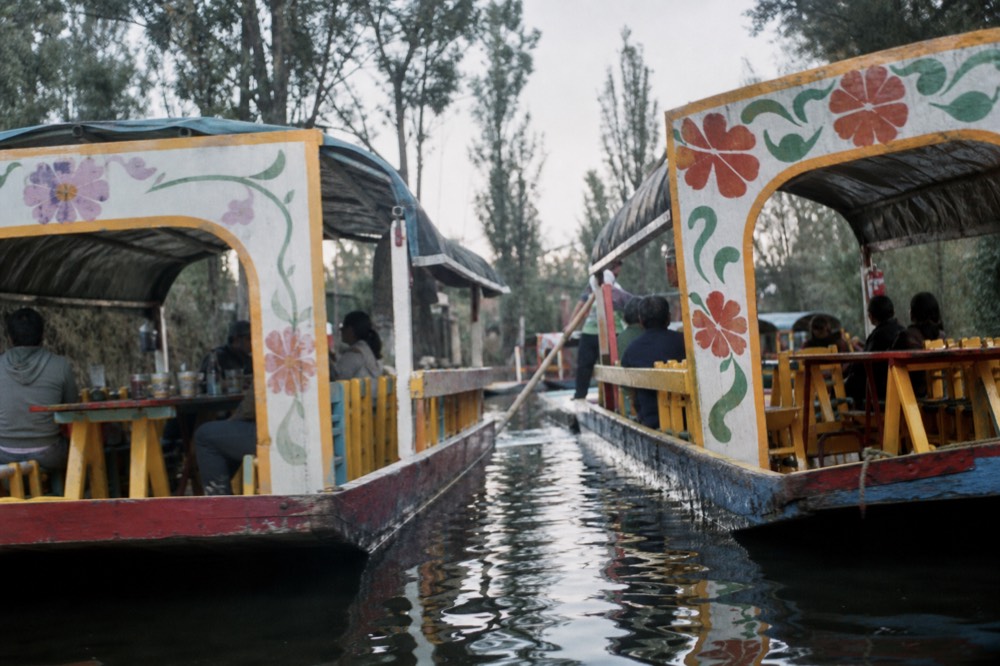
Pick an embarcadero, walk to the ticket window or the boatmen's stand, say how many hours you want, confirm the total in pesos out loud before boarding, and get on. Service runs roughly 8:00 to 18:00. Night rides exist but must be arranged in advance, not improvised at the dock.
Here is the sequence, in the order it actually happens.
Choose the dock first, not the boat. The character of your day is set at the embarcadero, not the hull. Nativitas is the biggest and loudest, with markets, mariachis and the full circus. Cuemanco and Fernando Celada are the quiet ecological end. Zacapa and Las Flores sit in between. El Universal's rundown of the embarcaderos covers the official list, and the dock-by-dock guide on this site compares them on crowding, atmosphere and access.
Say your hours before your price. The conversation goes: how many hours, then the total. Two hours, mil quinientos. If someone leads with a per-person number, that is your signal to walk to the next boatman, and there are always more boatmen.
Confirm the total out loud, in pesos, before you step on. Not the rate, the total. This one habit removes almost every dispute that visitors report.
Bring what you want to eat and drink, or plan to buy on the water. Standard daytime rentals allow you to bring your own food and drink, which is why you see families arriving with coolers, cake boxes and a portable speaker. The vendor canoes will find you regardless.
Bring cash. The docks and the vendor canoes run on pesos. Some ticket windows take cards, most vendors do not, and there is no reliable ATM once you are on the water. The cash question has the practical version of this.
Know when the clock stops. The hour count is kept by the boatman and it starts when you push off. If you want to extend once you are out, say so with time to spare rather than at the end, because he may have another booking waiting at the dock.
What to load onto the boat before you leave the ramp, in rough order of how much people regret forgetting it:
| Bring | Why | Note |
|---|---|---|
| Cash in small notes | The boat, vendors, music and toilets are all cash | Change for a 500 is scarce on the water |
| Sun protection | The canopy shades the table, not the open ends | The altitude here punishes bare shoulders |
| A layer for later | Afternoons cool fast once the sun drops | Rainy-season showers arrive quickly |
| Water, plus whatever you drink | Vendors exist, but not on demand | The quiet canals have far fewer canoes |
| Food from home | Allowed on standard daytime rentals | A cooler and a cake box is the local kit |
| A bin bag | There are no bins on board | Take everything off with you |
| Toilet paper and coins | Dock toilets charge, boats have none | Go before you push off |
| A charged phone | Photos, ride-hail back, splitting the bill | Keep it away from the open sides |
Skip the speaker if you are heading to the ecological docks. It fits the tourist canals and it does not fit the quiet ones, and the difference is obvious the moment you are out there.
How many people fit on a trajinera?
Posted limits run 18 to 20 people depending on the embarcadero and the boat, with smaller craft rated for fewer. Sources published by the borough and by the press do not fully agree on a single number, so treat 18 as the safe planning figure and confirm at the dock for your specific boat.
The practical answer differs from the posted one. A boat at its legal limit is a full boat: chairs down both sides, people at the ends, and no spare room for coolers, a cake, a speaker and a guitar case. For comfort, most families I know load a boat to around twelve or fourteen and treat the rest of the capacity as luggage space.
Two things follow from that. First, if you are a small group, you are paying for the whole boat anyway, so the per-head cost is high and a booked shared cruise may genuinely be cheaper. Second, if you are a group of ten or more, self-renting is almost always the cheaper option and gives you the day on your own terms. The line falls somewhere around eight people, which is where 1,500 pesos for two hours starts undercutting a per-seat ticket.
If you land on the small-group side of that line, the capped boat is the closer comparison: sixteen people maximum, guide, food and drinks on board, and you can check what a seat costs today before you decide.
What the vendor canoes cost
Smaller paddled canoes pull alongside your boat and sell food, drinks and music the whole way round. Recent reporting puts a mariachi song at around 300 pesos, a marimba at around 170, norteño groups around 230, and trios around 170. Beer runs roughly 40 to 50 pesos. Everything is cash, and prices are per song, not per set.
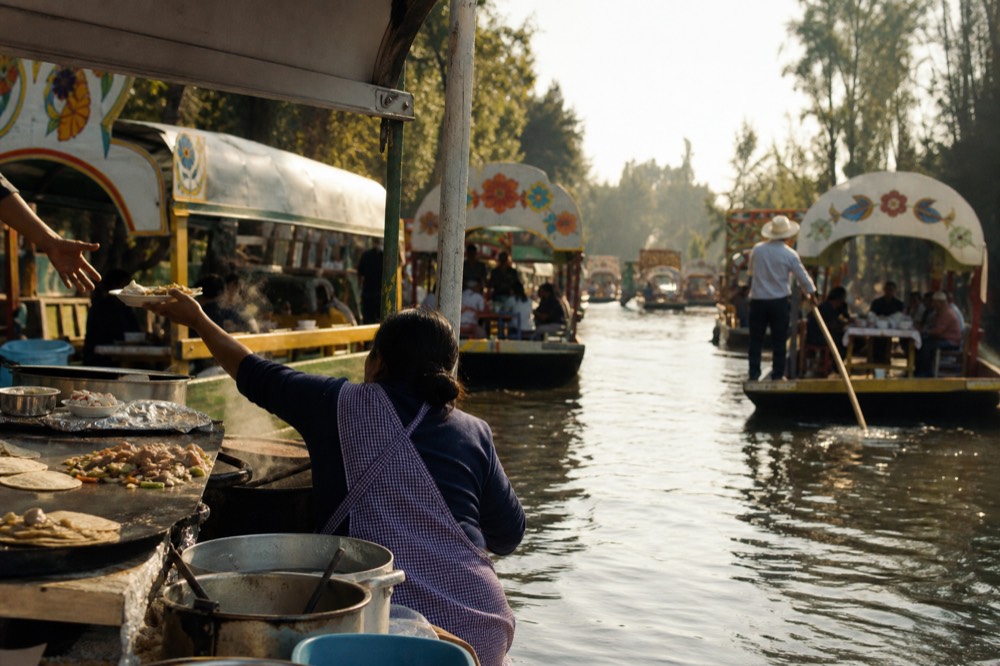
The vendor economy is the second half of the trajinera experience and nobody budgets for it. You are not on a boat with a bar, you are on a boat that other boats sell to. Some of them are floating kitchens with a griddle going. Some carry crates of beer and a bucket of ice. Some carry a band standing up in a canoe the width of a bathtub, playing at full volume while your boatman holds the two hulls together with one hand.
| What pulls alongside | Reported price | How it is charged | Notes |
|---|---|---|---|
| Mariachi group | around 300 MXN | Per song | The classic; negotiate a two or three song block up front |
| Norteño group | around 230 MXN | Per song | Accordion and bajo sexto, loud, excellent |
| Marimba | around 170 MXN | Per song | The cheapest live option and easier to talk over |
| Trio | around 170 MXN | Per song | Boleros; the one my grandmother always waved over |
| Beer | around 40 to 50 MXN | Per bottle or can | Cash, no change for large notes |
| Elotes, esquites, antojitos | Market rates | Per item | Sold from the cooking canoes, priced like a street stall |
| Michelada | Market rates | Per cup | Made on the canoe; bring your own if you are particular |
Music prices are per song, which is the single most expensive misunderstanding on the canals. A group starts playing, everyone claps, they play a second and a third, and the bill at the end is three songs at 300 each. Agree the number before the first note. Nobody is offended by this, it is how the transaction is supposed to work.
The food is worth eating, by the way. This is not captive-audience airport food, it is the same street cooking you would get on land, made on a canoe with a real griddle. The canal food rundown goes through what to order and what to skip.
Self-rental or booked tour: which one suits you?
Self-renting wins on price for groups of eight or more and on freedom for everyone. A booked tour wins when you are two or four people, when you want a guide who can explain the chinampas, when you do not want to negotiate in Spanish, and when you want food and drinks already on board.
| Hire it yourself | Book a shared tour | |
|---|---|---|
| Price basis | 750 MXN per hour, whole boat | Per seat, from $42 |
| Best group size | Eight or more | One to six |
| Food and drink | You bring it or buy on the water | Usually included |
| Guide | No, the boatman poles, he does not narrate | Yes, that is the product |
| Language | Spanish helps a lot | Guided in English on most listings |
| Getting there | You arrange it | Some tours include transport or pickup |
| Cancellation | You just do not show up | Twelve of the fourteen tours refund free at 24 hours |
| Negotiation | Every step of it | None |
Both are legitimate ways to spend the afternoon and I have done both many times. The tours are not selling you access to something restricted, they are selling you the removal of friction plus a person who knows what a chinampa is. If that is worth the difference to you, it is worth it. The traditional boat is the closest thing to a self-rental with a guide attached: see how it sits against the rest of the shared cruise bracket, or see today's price and the next departures on its own page.
If you want the independent route in full, from the light rail to the dock to the handshake, the do-it-yourself walkthrough is the step-by-step version.
Canal etiquette that locals follow and visitors miss
Six habits: agree music prices per song before the first note, do not stand up while boats are passing, keep bags away from the open sides, tip the boatman at the end rather than the start, do not swim, and take your rubbish off the boat with you.
The standing rule is the one that matters physically. Trajineras are stable, but when two loaded boats squeeze past each other in a narrow channel, the wash and the contact make the deck move, and people go into the water most often while standing up holding a drink. Sit for the passes.
The rubbish rule is the one that matters morally. This water is the habitat of an animal that has been pushed to the edge of extinction in the wild, with published density falling from roughly 6,000 per square kilometre in 1998 to 36 per square kilometre by the last survey. Every bottle that goes over the side goes into that. The axolotl guide explains why the water quality question is not sentimental.
On night rides: lunadas are a real tradition and I have been on many, but they are arranged in advance with an operator or a boatman, not decided at 20:00 at the dock. In 2026 Sedema banned unauthorised night parties with alcohol and lights on trajineras, and the borough tightened alcohol rules after a young man's death, so the improvised version has been shut down. Licensed daytime cruises are untouched. The party guide tells that whole story straight.
What does trajinera mean?
It comes from trajinar, the Spanish verb for hauling or carting things around, and trajín, the bustle of moving goods. A trajinera is a hauling boat. The name describes what these flat-bottomed craft did for centuries on the canals, carrying produce from the chinampa farms, long before anyone painted a canopy on one.
How much does a trajinera cost per hour?
750 MXN per hour for the whole boat, set by the borough, not per person. Two hours is 1,500 pesos whether there are four of you or eighteen. Anyone quoting a per-person rate at the dock is breaking the posted tariff. Vendor food, drinks and music are separate and cash-only.
How many people can ride one trajinera?
Posted limits run 18 to 20 depending on the dock and the boat, and smaller craft are rated for fewer. Confirm at the dock for your specific boat. For comfort, most families load to around twelve or fourteen so there is room for coolers, food and a speaker at the ends of the table.
Do trajineras have bathrooms?
No. The boats have a canopy, a table and chairs, and nothing else. There are toilets at the embarcaderos, usually for a small coin charge, and some landings along the route have facilities. Go before you push off, especially if you are booking three or four hours, and carry small change.
Can you bring your own food and drink on a trajinera?
On a standard daytime rental, yes, and it is the local norm: coolers, cake, snacks, a speaker. That freedom does not extend to unauthorised night parties, which Sedema restricted in 2026 along with tighter alcohol rules on the canals. Booked cruises have their own rules and usually include what you need.
Are trajineras safe?
Very, for a boat with no engine moving at walking pace in shallow water. The realistic risks are standing up while boats pass, drinking heavily in the sun, and losing a phone over the side. Life jackets are not standard issue on rentals. Do not swim: the canal water is not clean and the rules do not allow it.
Every bookable option, from the $42 sightseeing boat to the private chinampa days, is compared with live prices on the Xochimilco boat tours homepage. If you would rather do it the local way, take the 750 peso rate, find eight friends, and go on a Saturday.